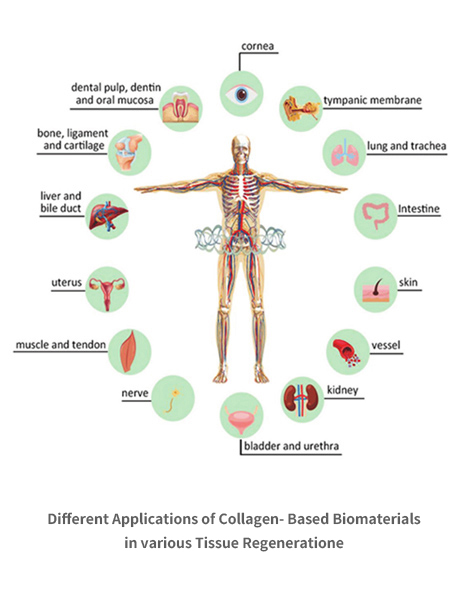
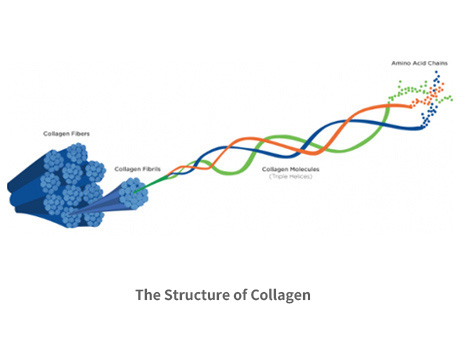
Collagen is the primary structural protein in humans and vertebrates, mainly synthesized by fibroblasts. As a key component of supportive and connective tissues, it serves multiple functions such as support, protection, and connection. The human body contains up to 28 different subtypes of collagen, categorized into fibrous and non-fibrous types. Structural analysis reveals that fibrous collagen macromolecules consist of three polypeptide chains tightly coiled into trimeric forms. These collagen trimers further align side-by-side to form larger fibers that intercross, endowing the final product with high mechanical strength. The normal triple-helical conformation of collagen underpins its physicochemical properties and biological activity, providing it with high tensile strength, biodegradability, low antigenicity, minimal irritation, low cytotoxicity, and the ability to promote cell growth, adhesion, and collaborative tissue repair when used as scaffolds for artificial organs or wound dressings. These characteristics make collagen an ideal biomedical material, widely applied in fields such as wound dressings, artificial organs, regenerative medicine, and cosmetics.
Collagen possesses a variety of excellent properties and versatile effects, making it widely used in cosmetics, healthcare products, food, and pharmaceuticals. In industrial applications, collagen is sourced not only from animal tissues such as pigskin, cattle hide, bovine bone, fish skin, and fish scales but also includes recombinant collagen, which has emerged with advancements in genetic engineering technology. Collagen from different sources varies in amino acid composition, molecular weight, thermal stability, and biological characteristics. Among them, recombinant humanized collagen employs gene sequences identical to human collagen, offering homology with the human body without rejection risks, eliminating concerns of animal-derived viruses, and providing enhanced safety, reliability, bioactivity, and biocompatibility compared to animal-derived collagen.
Soft Tissue Repair Materials
Collagen materials possess a natural porous network structure that rapidly adsorbs blood upon contact with wounds, promoting platelet aggregation while absorbing tissue exudates to create a favorable wound microenvironment and accelerate wound healing. Currently, there are numerous collagen-based soft tissue repair products in clinical use, including collagen dressings, dura (spinal) mater patches, artificial corneas, oral patches, hernia patches, and breast reconstruction patches.
Hard Tissue Repair Materials
Bone tissue defects or lesions are common clinical conditions. When autologous bone defects are too extensive to self-heal, treatment options primarily include autologous bone grafts, allogeneic bone grafts, and artificial bone implants. Autologous bone grafts are limited in supply and may cause secondary harm, while allogeneic bone grafts carry risks of disease transmission and immune rejection. Therefore, artificial bone materials hold broad application prospects. Collagen is the main organic component of natural bone tissue and is widely used in artificial bone tissue engineering materials. Currently, clinically used collagen-based bone repair materials are mainly composites of hydroxyapatite, β-tricalcium phosphate, bioactive glass, and collagen. These materials exhibit excellent biocompatibility and degradability, filling and repairing bone defect sites while inducing autologous bone regeneration.
Drug Release Carrier Materials
By controlling the structure of collagen materials, sustained drug release can be achieved, prolonging the drug's action time in the body to enhance therapeutic efficacy.
Tissue Engineering Scaffolds
Collagen serves as a scaffold material in tissue engineering, primarily providing an optimal living space and microenvironment for seed cells. Cells can grow according to the predefined three-dimensional scaffold structure and secrete new extracellular matrix, ultimately producing tissues or organs with specific shapes and three-dimensional structures in vitro.
3D Printing Technology Raw Materials
3D printing technology is rapidly advancing in the biomedical field, enabling precise control over the positioning, combination, and interaction of biomaterials, cells, and growth factors within the overall 3D structure. It also allows for the preparation of personalized medical devices for patients. Due to its wide availability, structural stability, and compatibility with other materials, collagen has become one of the commonly used raw materials in 3D printing.
Hemostatic Materials
Collagen can also be used in hemostatic materials. The subendothelial layer of blood vessels consists of a series of extracellular matrix proteins, among which fibrous collagen is the primary matrix protein that induces thrombus formation. When endothelial cells are stripped from the vessel wall, exposing collagen to the blood, platelets in the flowing blood immediately adhere to the collagen fibers, triggering aggregation and thrombus formation. Collagen promotes coagulation by activating coagulation factor XII and factors XI and V, as well as enhancing platelet clotting activity. Collagen used as a hemostatic agent can take various physical forms, such as powder, sheets, and sponges.